 ©Adaptive Cultures
Box 1:What is MetaNews?
The news attempts to make sense of the world; MetaNews attempts to make sense of the news.
We are all bombarded with news. There is 24/7 coverage across numerous outlets, the cacophony of social media and citizen journalists, along with burgeoning junk news, disinformation, and narrative warfare. In many ways the news itself has become part of the problem, as a staggering number of different articles and narratives make it hard to make sense of the world. We need a way to process the news in response to a disorganized and polarized media.
MetaNews uses analytical and computational tools to clarify what occurs within digital media landscapes. We examine thousands of stories as part of understanding important moments in recent news cycles, leading to a detailed analysis of a subset of representative stories from across the political spectrum. Each MetaNews feature creates an object lesson in media literacy by addressing consequential and polarizing issues in the news while at the same time equipping readers with insights into the total news landscape. Looking carefully at the complex dynamics of a specific news cycle allows for an introduction and explanation of patterns and principles that can be applied broadly for purposes of improving public understanding.
Introduction: As Violence Escalates, Clashing Explanations
We’re going to look at a news event from the summer of 2020 that remains cloudy in many people’s minds because the coverage of it varied from outlet to outlet and was shaded by overt or hidden biases. In other words, pretty typical for anything touching on politics. We’ll dive into how and why this event is so difficult to pin down, offer some tools for figuring it out, as well as offer some thoughts on how the media might improve.
On the morning of May 31, 2020, a journalist in Raleigh, North Carolina, tweeted what appeared to be a photo of her office, taken in the daylight, the windows completely shattered: “I’m devastated,” she wrote. “We are a progressive newspaper. Last night I was inside when the first brick was thrown.” [1] Across the country that morning, cities were cleaning up broken glass and debris from the sidewalks. Later, downtown shopping and business districts in many cities would begin boarding up their storefronts in preparation for the nights to come.
During the final weekend of May 2020, peaceful protests turned into violent conflicts, as riots and looting broke out in several cities including Raleigh, Minneapolis, and Dallas. COVID-19 lockdowns and the resulting economic downturns (mostly affecting the poor) deepened the partisan strife and racial conflicts that were being brought to the streets. The summer’s protests for racial justice were planned as non-violent marches but once sparked, rioting and looting escalated quickly in some areas. Early events in this escalation involved the use of rocks, bricks, and other projectiles to break windows and to assault police, as well as widely shared footage of conspicuously dressed individuals destroying storefronts, who were apparently not part of the Black Lives Matter (BLM) movement.[2] In this context, based on a series of viral social media posts that showed large piles of bricks near protest sites, speculation began to circulate that agent provocateurs were planting large piles of bricks in an attempt to escalate violence.
The idea that bricks were being planted began to circulate among BLM activists, spokespersons for the police, and local politicians, who appear to have had sincere concerns that agitators were exploiting peaceful protests. Police claimed groups such as Antifa might be planting bricks as part of organized violence against the state, while protesters suggested that the police or federal authorities might themselves be strategically planting bricks to escalate and thus delegitimize the protests. Many major media outlets factchecked the stories and dismissed them as unfounded and conspiratorial. With emotions already boiling, these competing claims about planted bricks spread because they were inflammatory. After three weeks in the news cycle, this issue left public awareness almost entirely, without ever having been adequately addressed. The news cycle as a whole had the result of leaving readers a bit more polarized, hostile, and confused, presenting a world in which groups have basically unreconcilable views about important issues.
The idea that bricks were being planted began to circulate among BLM activists, spokespersons for the police, and local politicians, who appear to have had sincere concerns that peaceful protests were being exploited by agitators.
MetaNews analysis is useful in addressing this news cycle after the fact, not just to make sense of the issues, but to use it as an object lesson in the types of dynamics leading to polarization and radicalization in our current culture and public sphere.
In this case, one of four things might be true: there were piles of bricks planted to tempt demonstrators; there were piles planted by demonstrators; there were innocent piles of bricks used in building sites that happened to be near demonstrations; there weren’t any piles of bricks near demonstration sites. It’s also true that one of these four was true of one or some sites, but not all. Did the media get to the truth of the matter?
Our analysis of this news cycle shows that while there has been little evidence to date of any coordinated effort to plant large amounts of bricks at protest sites, claims about the activities of agent provocateurs have been left unresolved, despite this being the primary concern of both protesters and police on the streets.
Important questions remain open about these events and the news cycles surrounding them. This MetaNews investigation finds major media outlets did little to enhance public understanding of what actually happened. Polarization dynamics in the media resulted in fundamentally inadequate coverage, with consistently poor arguments and weak evidentiary grounding across the board, as will be addressed in a series of explanatory boxes below. In general, there was a failure by major media outlets to provide for a complex discussion of what occurred at the protests. This deepened polarization and suspicion rather than resolving it, because obvious and important issues remained unaddressed.
Meet Brickie:
 Figure 1: Meme created and circulated among activists and supporters of protests.
Figure 1: Meme created and circulated among activists and supporters of protests. Note in the lower right corner a message suggestion that authorities might be surveilling social media posts about the protest.
Tracking the News Cycle: Bricks in the Headlines
Protests related to the death of George Floyd began on May 26. By May 29 many initially peaceful protests had turned violent, with some officially declared riots. Our focus is media coverage between May 30 and Jun 9. The media landscape polarized around this escalation, as so-called “bait bricks” were at the center of an eruption of divergent news coverage. Drawing the analysis into focus, our team sifted through more than a thousand stories to distill a smaller subset of widely shared pieces that specifically mention what became labeled in social media as “#baitbricks.” This brought the total number of unique relevant stories to just under 70, which we then analyzed thematically and in terms of their arguments and evidence. See MetaNews methods section for more details. Link to methods document. What did we do? A snapshot of the stories we looked at can be seen in the following figures. These show the results of our analytical sweep through one of the largest databases of media output that is publicly available. The figures provide context for the detailed overview of the narrative landscape offered in the next section.
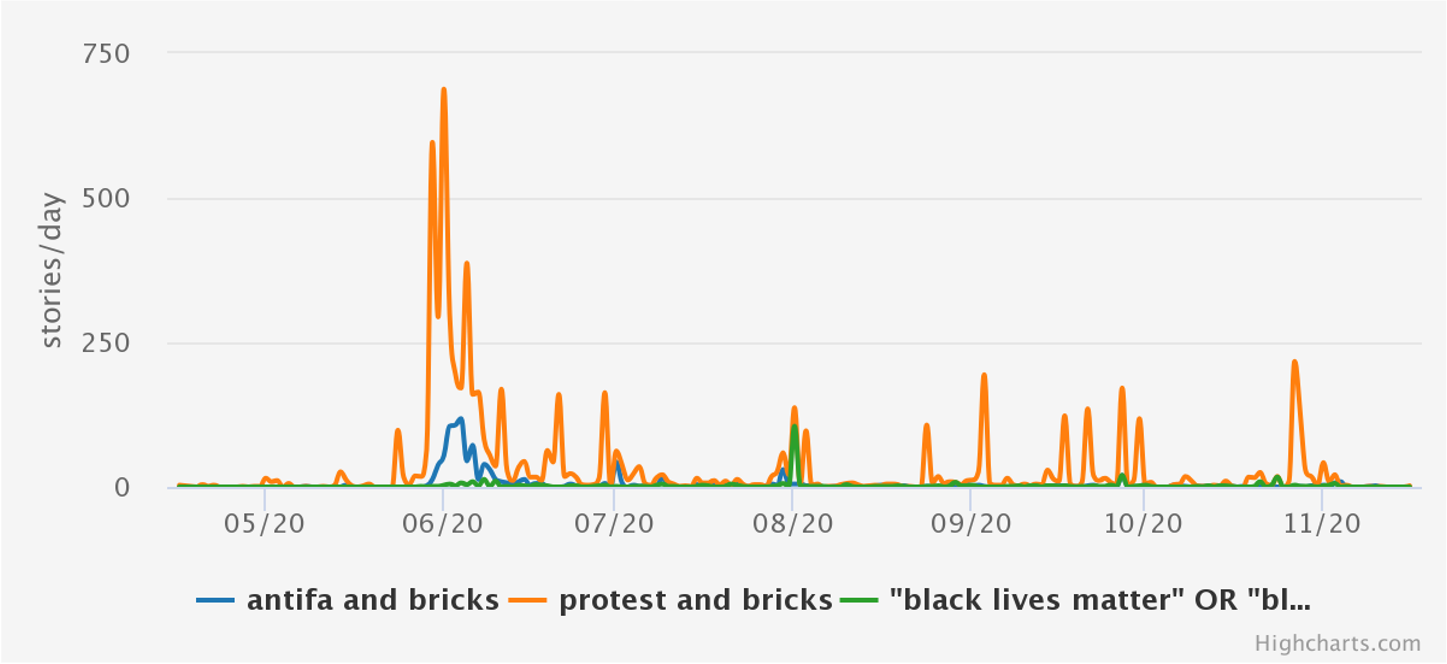 Figure 2: media attention timeline.
Figure 2: media attention timeline. This figure was produced via MediaCloud datasets and tools. The results are based on separate query string words of “bricks” and “protest” or “antifa” or “blm” or “black lives matter” between 16 April -16 November 2020. The first spike in media attention about “bricks” and “protests” is on May 30th with 592 stories, followed by the high on 1 June with 674 stories. Antifa, rather than the Black Lives Matter movement was linked to the placement or usage of bricks at the protests, if any attribution was made. The spike of the media reporting on Antifa in relation to bricks correlates with tweets by President Trump on May 31st attributing claims of protest violence to the group.
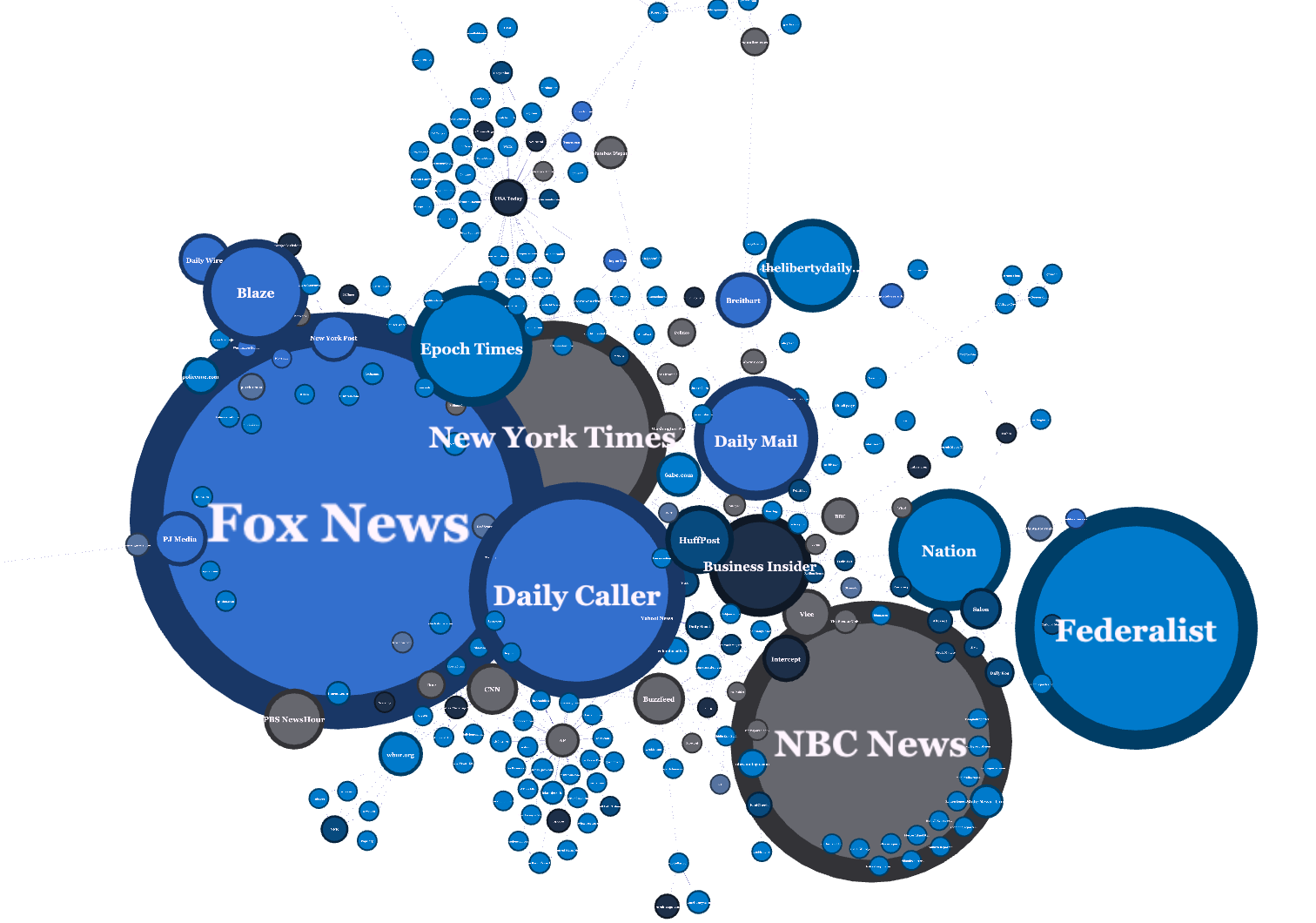 Figure 3: media landscape influence-bubble graphic.
Figure 3: media landscape influence-bubble graphic. The figure depicts our sample of stories and their aggregate Facebook shares by media outlet. This shows which media organizations were influencing the narrative through their reporting and then subsequent shares on Facebook. Out of the top ten most shared media organizations (the largest bubbles) in our sample, six of those organizations (Fox News, The Federalist, Daily Caller, The Nation, Epoch Times, Blaze) are considered as right slanted, with four of them considered far right organizations whose reporting was deemed as having high variation in reliability, according to AdFontes Media, which is a source we regard as reliable, with transparent funding, and open verifiable methods. A majority of the more established, mainstream news organizations, such as the largest bubble, Fox News, had over 238,000 shares due to producing the most content (57 stories from search queries). Outlier news organizations, such as the hyper-partisan outlet The Federalist (whose content was judged by Ad Fontes to be “Selective or incomplete story/unfair persuasion/propaganda”) had only one article produced based on the search query, but the article dominated in virality on Facebook: “Media Falsely Claimed Violent Riots Were Peaceful and That Tear Gas Was Used Against Rioters,” led all articles with over 133,000 Facebook shares. The graphic was produced using MediaCloud datasets based on separate query string words of “bricks” and “protest” or “antifa” or “BLM” or “black lives matter” between 16 April -16 November 2020. This was then exported into the Gephi network analysis platform for dataset attribute analysis.
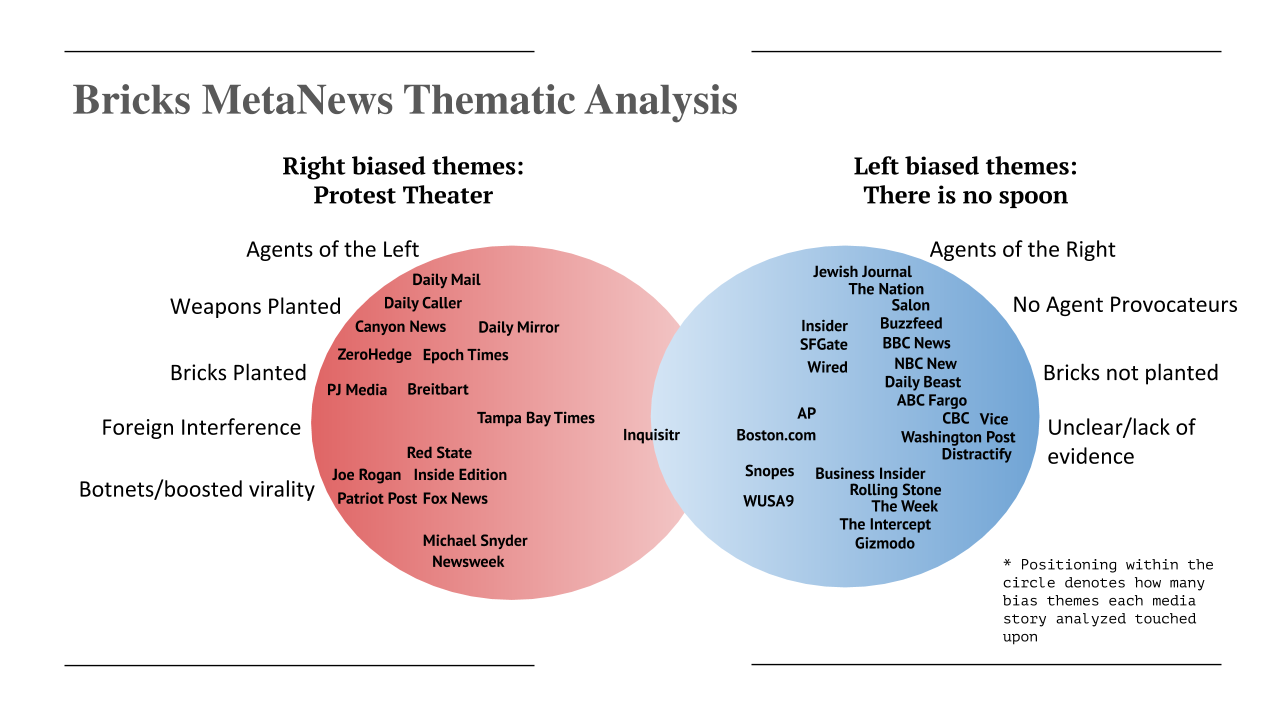 Figure 4: thematic analysis diagram.
Figure 4: thematic analysis diagram. The themes listed on the outside of the circles were the top themes noted across the majority of the reporting analyzed. While far right themes appeared to revolve around inflammatory language, far left themes frequently appeared to try to downplay the matter significantly, seemingly with little investigation, and taking a “de-escalation” stance against claims of attribution to highly organized leftist groups with violent agendas. Media organizations are positioned in the graph based on which themes they contained in their reporting, which fell largely along partisan lines. The closer a media organization sits to the outer edge of each circle (and subsequently, closer to the themes) is representative of how many polarizing themes the outlet touched upon in their reporting. On the right, sites like ZeroHedge consistently reported that the bricks were planted, alluded to agents of the left, and inferred other weapons were planted as well. On the left, however, mainstream giants like the Washington Post appeared to refuse to even address theories such as planted bricks at protests, outside of their opinion columns (their fact-checker gave this claim “four Pinocchio’s” meaning it was false). Instead, their primary reporting focused on “debunking” claims of organized outside influence on local protests. This graphic and the associated analysis was created based on thematic, contextual analysis of 70 sample articles across a variety of media mediums (podcasts, mainstream, alternative media, webcasts, etc.), as selected by our researchers as representative of the reporting in our overall sample.
Overview: What Happened?
Part One
A Meme in the Making: Viral Videos of Bricks on Social Media
Within the 70 stories we analyzed, the first posts and tweets stand out as frames.
On the night of Friday, May 29, a Dallas protest reportedly turned violent, with some protesters throwing objects at police officers. The next morning, a Dallas law enforcement officer tweeted a picture of an injured police horse and burned out cars, with the comment: “Protesters here in Dallas threw bricks at the mounted patrol, harming at least one horse’s head.”[3] A local news station interviewed the Dallas Police Chief, who said a squad car had been suddenly pelted with bricks.[4] Her remarks indicated that officers were dealing with considerable chaos, and that it was impossible to determine who was throwing bricks, bottles, and other items at the time.[5]
Late on May 29, or in the first hours of May 30, BLM supporter and a participant in the Dallas protest, Reuben Lael, posted a video to Instagram. Lael’s video showed a pile of bricks outside a Dallas courthouse, with Lael standing nearby commenting that he served jury duty three months before, and there had been no bricks there at the time. He emphasized the courthouse location and confidently declared the presence of the pallet of bricks as a “set up.” The video message was clearly aimed at people who were familiar with Dallas and probably known to him personally. He ended by saying “Y’all know what building this is [the courthouse] . . . I ain’t even gonna say [its name] . . . You gotta do better . . . Y’all don’t keep no bricks right there [normally] . . . Do better . . . I see you.”
Later Saturday morning, Lael posted his video on his own Twitter feed, with the following comment: “The Dallas protest was a lot of things. But I was very disappointed to see this RANDOM stack of bricks in front of the courthouse. #setup #BlackLivesMatters #makeblackcount”.[6]
Parts of the tweet suggest that Lael believed a familiar trap was being set up—leaving bricks within easy reach of angry protesters—to make BLM and/or its allies look violent, presumably to discredit the cause. In the video clip, another protester is heard commenting that there is no construction going on in the area, apparently in agreement that the bricks had been planted to cause trouble for BLM and/or its allies.[7]
That night, apparently in response to tweets like this one, another self-identified BLM supporter, tweeted a video clip of people crowded around “random bricks” in Fayetteville, North Carolina.[8] The video was filmed during the day, and shows the public casually looking at a neat pile of bricks on a downtown (brick) sidewalk, cordoned off by orange traffic cones. This tweet got considerably less engagement than Lael’s, but did achieve some circulation on Twitter. The bricks looked similar, like generic bricks used for paving city sidewalks.
May 31, a Sunday, was a day of increasing national political strife. In the early afternoon, President Trump tweeted that he planned to designate “Antifa” as a terrorist group. This came amid nation-wide complaints by officials that outside agitators of some kind were responsible for violent protests in their cities.[9] Speculation similar to Lael’s was being echoed by officials in several cities, including New York, Boston, and Washington D.C.—all politically liberal. This appears to have been mostly based on several years of clashes between police and “anarchist-type” agitators who infiltrated peaceful protests, rather than something well-supported by evidence in this particular case. Some of the officials noted it was hard to track down the suspects and that little was known about their activities.[10]
The bricks were now more than the confused speculation of local politicians in a few cities. It was a national political narrative for those closely following events online.
That same Sunday, popular right-wing news site Breitbart published a story on Lael’s tweet, which included a reply to Lael suggesting he was referring to Antifa involvement.[11] Other major media outlets soon followed. They referred to other social media reports about bricks, as well. The bricks were now more than the confused speculation of local politicians in a few cities. It was a national political narrative for those closely following events online. The topic of provocateurs among the protesters took off among politically engaged social media users.
Box 2: How fast can good understanding take place about this issue?
Within 48-hours of the first #baitbricks video being posted, it had gone viral and was picked up by major media outlets. Over the course of only a week, the story had fractured into competing narratives, each of which presented plausible claims as true. Today’s news cycles unfold faster than at any point in the history of news media. Psychological, social, economic, and political pressures incentivize coming to conclusions about complex topics as quickly as possible. The stories in our sample demonstrate this: the amount of writing aimed at closing open questions far exceeded that which opened new questions or took account of those left open.
People have a natural desire to want to understand causation, and to explain and understand the events taking place around them. This is particularly true when what’s happening is consequential. The majority of people want instant gratification. These issues are, of course, compounded by the cell phone, loaded with social media apps, as an ever-present source of constantly updated news.
Good research is slower than fast conjecture. While intuitions and insight can come fast, confirming them takes time. The more complex the question, the more time it takes to do sufficient inquiry concerning it. This relationship between complexity and time is almost universal, which raises real concerns about the speeds at which certain kinds of claims are being made in the news media.
Understanding the speed at which certain kinds of questions can be answered is essential for evaluating the quality of the news cycle and one’s own individual opinion formation.
Part Two
Protest Theater: Right-leaning Media Outlets Run With the Story
On Monday, June 1, Fox News led with a story that opened: “Social media users participating in protests over the death of George Floyd have reported large piles of bricks randomly appearing at rallying sites.” Fox attributed the virality to @Breaking911, “a Twitter handle with nearly 700,000 followers,” who had tweeted that “videos continue to surface showing protesters stumbling upon pallets of bricks or pavers in areas with no construction taking place.” It also commented that there were several theories in play, “…ranging from them being planted there by police so rioters could face tougher charges, to outside agitators trying to stir up more trouble.” While the article referred to the people in the video as “rioters,” it also noted that rapper “ICE T, who has spoken out against police brutality and in favor of the protesters,” had posted one video with the comment that it “look[ed] like a set up.”[12]
It soon became fairly common to refer to the phenomenon as “bait bricks,” and then eventually #baitbricks.
It soon became fairly common to refer to the phenomenon as “bait bricks,” and then eventually #baitbricks. The story gained popularity on “alternative” American media sites, often right-learning or anti-establishment in nature, like the popular ZeroHedge. The outlet often acts as a news aggregator, and throughout the day, it updated a post with various claims related to the bricks controversy.[13] ZeroHedge, which focuses on financial and investment news, frequently reprints the work of other alternative media writers, and on June 2, it reprinted a long piece on this topic.
The author argued, “The protests against police brutality have been hijacked by sinister forces, and they are attempting to channel the outrage over George Floyd’s death in a very violent direction,” and that “law enforcement authorities all over the U.S. are telling us that they have identified a highly organized effort to orchestrate violence, and this appears to be happening on a nationwide basis.” He highlighted two claims from mainstream U.S. media: “On Sunday night, New York’s top terrorism cop, Deputy Commissioner for Intelligence and Counterterrorism John Miller, detailed his office’s analysis and investigation into why the New York City protests have become so violent and damaging at times,” blaming “organizers of certain anarchist groups.” And Chicago Mayor Lori Lightfoot “publicly acknowledged that “‘there has been an organized effort’ to turn the protests over George Floyd’s death ‘into something violent’ in her city,” leading her to ask three federal agencies for help, though she wouldn’t name who she thought responsible. A New York police official was quoted as seeming to suggest “that someone has been stealing bricks [from construction sites] and leaving them in pre-staged piles for the rioters.”[14] Additionally, on June 2, Joe Rogan (who does not identify as conservative or liberal) discussed one of the clips on his popular podcast, arguing in favor of the idea that piles of bricks were likely being planted.
Also, on June 2nd, CBS’s newsmagazine television program, Inside Edition, included three clips related to the brick narrative. Viewers were told that “police say small bands of the so-called ‘professional agitators’ are taking advantage of the crisis and hijacking peaceful demonstrations.” This included “piles of bricks” appearing at demonstration sites, resulting in “speculation they may have been planted there by Antifa for use as projectiles aimed at cops and storefront windows.”[15] Meanwhile, the official White House account (not the POTUS), tweeted “Antifa and professional anarchists are invading our communities, staging bricks and weapons to instigate violence.” The tweeted post included a compilation of seven brick-related clips, including the three that had just aired on Inside Edition. They continued, “These are acts of domestic terror.” In its coverage of these events, The Intercept, a left-leaning investigative outlet, omitted the final line of the White House tweet, though it provided a screenshot: “The victims are the peaceful protesters, the residents of these communities, and the brave law enforcement standing watch.”[16]
Box 3: How does the emotional motivation to explain something affect judgments about what makes for an adequate explanation?
The #baitbricks stories in our sample can be understood in light of a strong motivation shared by many people to explain the events taking place, as some peaceful protests transformed into violent riots. In many stories there was insufficient attention given to the limitations of what could be known about events taking place in the streets. While specific cases of bricks could be investigated, much of the broader speculation surrounding events was clearly marred by “motivated reasoning”—where a conclusion is reached for emotional reasons rather than on the basis of adequate evidence and unbiased inquiry.
There is strong motivation to explain the world around us quickly, and in ways that can be understood and embraced by others. But there is often a distance between what needs to be explained and what can be explained, given current information and ability. This distance can be large, in which case there are strong tendencies to overestimate explanatory capacities or underestimate the complexity of what needs to be explained.
The role of motivations and emotion in conveying understanding cannot be overestimated. This includes our discomfort with uncertainty, the desire to belong and be part of an ingroup by sharing a world view, and the desire to not be shamed. There is an intrinsic reward associated with pattern recognition, and with the status conferred by saying something that gets amplified, even if by strangers or undiscerning people.
©Adaptive Cultures
Part Three
The Narrative Splits: Left-leaning Outlets Engage
To this point, the prominent commentary was being driven by concerns that peaceful BLM protesters and their allies might be taken advantage of by people looking to use the protests to engage in criminal behavior or violent political agitation. Most observers were warning the protesters themselves, especially BLM members, even as very few were specific about the suspected opportunists’ identities and motives. However, during the next 48 hours a competing narrative began to propagate through many of the major media outlets. Claims of planted bricks were simply false and may be driven by right-wing conspiracy theorists attempting to delegitimize the protests. The bricks were part of ordinary construction projects, and fact-checking will settle the affair.
The story so far, our analysis shows, was confusing, and it was about to get even more confusing. This is common for many breaking news stories. A burst of “facts” later modified or retracted entirely as new “facts” emerge from more witnesses, online sleuths and videos.
Some outlets used open-source intelligence (OSINT) investigative methods to debunk some of the claims. For example, some of the accusations were plausibly debunked when journalists turned up evidence that the bricks were connected to local construction projects in Dallas and other cities. They located Google satellite images from weeks earlier in which brick piles were visible, as well as records of permits for road maintenance. An NBC News piece noted that “NBC News’ Verification Unit geolocated the photos and tracked down the bricks to a Dallas parking lot. They have been there for months, close to a construction site, and can be seen in an image on Google Maps Street View from February.”[17] They included a photo, but it is small, and the details are hard to make out, and they did not include the photos circulating on social media for comparison, as other sites that used similar methods did. In this case, like some others, it was not possible to unquestionably confirm the bricks were the exact same ones in the viral videos, as they appear to have been moved a short distance and rearranged. But it is a highly plausible suggestion, and at the very least evidence of a construction site receiving shipments of bricks.
Other news outlets “debunked” the story by contacting authorities in cities where reports of bricks had surfaced, asking for confirmation. The most extensive coverage of the brick matter was on June 1 and 2, as media outlets returned from the weekend to cover the story with new focus. The Associated Press spoke to the police chief in a Texas town where bricks were found and was told they had been left there for construction purposes, not for mayhem.[18] This is plausible, but no police reports, or other witnesses were used to corroborate this. NBC News also referred to this town in its coverage: “the local police later put out a tweet saying they’d investigated, the bricks were for a planned construction project, and they’ve been removed,” which was accepted at face value, though the tweet that sparked controversy had referred to piles of bricks. [19] Newsweek reached out to the Kansas City Police and got a response from its “chief information officer,” who told the publication that they had been tipped off to the presence of a pile of bricks and, as a precautionary measure, had seized the potential projectiles. He acknowledged, however, that there was no “confirmed direct info that they were placed there by protest groups.”[20] It is hard to see how authorities would be able to conclusively prove such allegations, particularly so quickly. On top of that, allegations of criminal activity are usually handled in court, not by statements from the local police public relations office.
The prior Sunday, the police department in Kansas City, Missouri tweeted, “We have learned of & discovered stashes of bricks and rocks in & around the Plaza and Westport to be used during a riot.” The tweet was aimed at peaceful protesters: “If you see anything like this, you can text 911 and let us know so we can remove them. This keeps everyone safe and allows your voice to continue to be heard.”[21] This kind of “official” tweet may have played a role in the story going mainstream among protestors.
To understand the news cycle properly it should be noted that on that same Sunday, May 31, NBC News ran a lengthy piece on conflicts in recent years between police and “homegrown anarchists,” using the term “anarchist” almost interchangeably with “Antifa.” NBC said these groups were “focused on creating damage and inciting violent confrontations with police (and possibly other protesters) in the name of anarchist and Antifa causes.”[22] The piece did not focus on the recent protests or mention bricks, but it did note that in recent years, anarchists and Antifa tended to compile projectiles and frequently aimed to sow unrest “before the first demonstration and or before the first arrest,” and that they were now suspected to be infiltrating New York City protests. This piece is a useful marker for the rapid narrative shift among major media outlets on the center-left and left over the next 24-48 hours. By June 2nd, NBC News would be fact-checking to promote the idea that all claims of bricks and conspiracies to promote violence were false, although they did acknowledge that some bricks had been passed around and thrown at protests.[23] Ensuring Antifa was not associated with violence at the protests appears to have become a major narrative-management goal for the left from June 2 onward.
This was followed by a breakdown of the claims and how they were fact checked, with a note that the post would be updated with new information as it became available.
Around the time the Inside Edition episode aired, Buzzfeed News, a left-leaning popular news site, posted an article about “rampant speculation that the bricks are part of a coordinated effort to incite violence as a way to entrap protesters and instigate chaos.”[24] It noted that “BuzzFeed News has documented claims made about bricks in Boston, Dallas, Kansas City, San Francisco, and elsewhere. In several cases, bricks were placed long before protests began in the U.S., or they are clearly linked to ongoing construction. As of now, there’s no evidence to support claims of coordinated brick placements at protests.” This was followed by a breakdown of the claims and how they were fact checked, with a note that the post would be updated with new information as it became available. The breakdown included an NBC News producer debunking claims about bricks in Dallas, showing a Google Street View image that proved the bricks had been there since at least February and that there was a nearby construction site. The article included a screenshot of a tweet about the Dallas bricks that said the government was trying to create an excuse to impose martial law on BLM and other protesters across the country, a narrative that continued to gain ground in some circles. Buzzfeed acknowledged, …“in spite of those details (provided by fact checkers), the Dallas bricks are now being woven into the sprawling QAnon conspiracy theory.” Buzzfeed further noted that QAnon followers “baselessly claimed the bricks are from a company owned by billionaire investor Warren Buffett, and that they have ties to Bill Gates and other powerful figures.”[25]
Box 4: What claims should be kept distinct and how can they be independently evaluated?
The stories in our sample consistently involved two distinct claims, which became illogically entangled throughout nearly all coverage.
Claim 1: There are “agent provocateurs” seeking to take advantage of otherwise peaceful protesters, using the opportunity to incite violence by strategically escalating tensions at protest sites.
Claim 2: These “agent provocateurs” intentionally planted piles of bricks in specific locations, examples of which have been captured by video footage taken by protestors and circulated on social media.
In many of the major media outlets the second claim (that bricks were planted) was explicitly investigated as a factual matter. This was much of the coverage. The majority of specific claims were shown to be invalid, and in some cases, it could be demonstrated almost beyond a reasonable doubt that the bricks in question were for construction projects that happened to be near the protest site. However, because the two claims were entangled, the invalidation of specific cases of bricks became mistaken for an invalidation of the claim that there were agent provocateurs at the protests.
The general claim about agent provocateurs is separate, and more complex to deal with. It cannot be resolved based on limited investigation. Stories in our sample offer firsthand evidence of BLM protesters and police that suggest the claim of agent provocateurs remains separate and plausible, even after the various videos of bricks were investigated and resolved. Investigations that conflated these claims often contradicted the evidence captured by people on the ground at the protests; police and protesters seeking to explain what they witnessed during the escalation of violence. The claim that there were no agent provocateurs is plausible but should not be presented as true based on evidence only relevant to claims about specific piles of bricks being planted. Likewise, the claim that certain piles of bricks were planted is plausible but should not be presented as true based on the strength of evidence concerning the presence of agent provocateurs.
Conflating claims in ways that mislead is a dramatic problem impacting the media at large. It can be done inadvertently, by mistake, when articulating arguments too quickly. But conflations can also be engaged intentionally, as an aspect of frame control and narrative warfare [see Box 6].
Box 5: How much weight should be given to various seemingly plausible narratives?
In much of the coverage we analyzed plausible ideas were presented as if true. The very first video presented a claim as true that was merely plausible: that bricks had been planted near protest sites by agent provocateurs seeking to increase violence. The first stories that followed amplified this error. This practice of presenting a plausible hypothesis as if true ranks as one of the most common problems within current media. Sometimes this is done accidentally, when claims are made in haste or with an honest misunderstanding of the data. However, the practice of presenting a plausible hypothesis as if true is also undertaken intentionally, as a technique of informational and narrative warfare.
One classic technique is the use of leading questions and insinuations: “Couldn’t it be true that…” “How do you know for sure that they didn’t…” “Isn’t it convenient that…” “Isn’t it strange that that… “Sure seems to be quite a coincidence that…” This often involves social shaming associated with not getting the correlation (even though unvalidated): “You’d have to be an idiot (or member of some disliked “outgroup”) to not realize…” (See Boxes 3 and 8 for more on the social and psychological dynamics involved.)
As the narratives about bricks polarized, ungrounded assertions circulated widely, and plausible ideas were presented as if true. On Fox News and ZeroHedge the story of planted bricks was presented as if simply true, and insinuations of possible larger plots were offered. Some of the suppositions were actually in the realm of “unfalsifiable,” hinging on claims requiring evidence that cannot (in principle) be obtained. Presenting plausible hypotheses as if true sets off a polarization dynamic that is hard to contain: different groups are able to claim “their own truths,” making the situation fundamentally irreconcilable (see Box 4 for understanding how unverifiable claims create irreconcilable views).
Best practice is to explicitly gauge and discuss the plausibility of a claim when presenting them. Hypotheses should ideally be ranked in terms of their plausibility, as the availability and quality of evidence dictates. This ranking itself is open for discussion and revision. Those claims that can be easily verified should be, and kept distinct from those that require more inquiry, and from those that are in the realm of what is unverifiable.
©Adaptive Cultures
Part Four
With the Narrative Polarized, Frame Control Begins.
At this point, especially on a sensitive or controversial story, it’s normal for each “side” to develop ways to frame the story to their liking.
By June 3, most left-leaning U.S. media outlets started to push a common debunking narrative. A reporter from the BBC, Benjamin Strick, got the majority of the credit in the American press for his disinformation team’s debunking story, upon which other left-leaning reporters quickly built a similar narrative. Most followed BBC and Buzzfeed, engaging in open-source journalism to pick apart claims from afar, cross-checking social media claims against various databases.[26] The Intercept claimed that Vice, another left-leaning investigative outlet, had helped demonstrate that almost all of the videos “showed ordinary piles of bricks used in construction projects.” However, Vice’s June 3rd piece noted that the controversy had been much aggravated by the fact that “NYPD Commissioner Dermot Shea posted a video on Twitter of an NYPD officer on a street corner, facing what look like several blue plastic bins full of bricks or concrete chunks. ‘This is what our cops are up against,’ he wrote. ‘Organized looters, strategically placing caches of bricks & rocks at locations throughout NYC.’”[27] Vice claimed to have already investigated and debunked the story, but this was either not known or ignored by the Commissioner.
A widely republished Associated Press piece[28] stands out as a clear example of frame control around the issue of Antifa involvement in the protests.
Here are the first few paragraphs:
As Trump blames antifa, protest records show scant evidence
By MICHAEL BIESECKER, MICHAEL KUNZELMAN, JAKE BLEIBERG and ALANNA DURKIN RICHER
June 6, 2020
WASHINGTON (AP) — Scott Nichols, a balloon artist, was riding home on his scooter from the protests engulfing Minneapolis last weekend when he was struck by a rubber bullet fired from a cluster of police officers in riot gear.
“I just pulled over and put my hands up, because I didn’t want to get killed,” said Nichols, 40. “Anybody that knows me knows I wasn’t out there to cause problems.”
Nichols, who before the coronavirus pandemic made his living performing at children’s birthday parties under the stage name “Amazing Scott,” spent two days in jail before being released, facing criminal charges of riot and curfew violation.
President Donald Trump has characterized those clashing with law enforcement after George Floyd’s death under the knee of a Minneapolis police officer as organized, radical-left thugs engaging in domestic terrorism, an assertion repeated by Attorney General William Barr. Some Democrats, including Minnesota Gov. Tim Walz and Minneapolis Mayor Jacob Frey, initially tried to blame out-of-state far-right infiltrators for the unrest before walking back those statements.
There is scant evidence either is true.
The Associated Press analyzed court records, employment histories, social media posts and other sources of information for 217 people arrested last weekend in Minneapolis and the District of Columbia, two cities at the epicenter of the protests across the United States.
Rather than outside agitators, more than 85% of those arrested by police were local residents. Of those charged with such offenses as curfew violations, rioting and failure to obey law enforcement, only a handful appeared to have any affiliation with organized groups.
There is little attempt to convey a logically coherent and well-grounded narrative.
There is little attempt to convey a logically coherent and well-grounded narrative. The evidence presented by the AP to make their case is insufficient. For example, while they claim to be investigating violent agitators at the protests, what few arrests records they look at are not for individuals convicted of crimes involving major violence or property damage. There’s no reason given as to why data was limited in this fashion, nor as to why generalizations about nationwide violence can be gleaned from a small sample of nonviolent arrest records. However, there is enough internal consistency that a casual reader, especially one who gets information mostly from similar sources, would likely understand the interpretive conclusion embedded in the story thanks to the frame employed. The casual reader could fill in the blanks with their own associations and “decode” the general message, that all claims of radical protest interference were absurd, and probably just malicious nonsense from the political opposition. Interestingly, the AP’s headline was “As Trump blames antifa, protest records show scant evidence.” As is often the case with online media, the content did not match that headline. In this case, with even more than typical exaggeration, we find a misleading claim of empirical evidence.
Box 6: How can information be framed to be holistically representative of the full range of information available?
Some of the #baitbrick coverage deviated markedly from common news narrative format, going too far in cherry-picking narrative elements. Some media outlets were emphasizing claims and evidence that ran counter to an accurate and comprehensive picture of the facts that were known. Frame control is a form of motivated reasoning where a political or ethical commitment is used to frame what is selected for discussion and presentation. This can be done in haste, or unconsciously. But sometimes the work of frame control takes place intentionally. Instead of trying to accurately communicate a story that properly reflects known information, facts and evidence are cherry-picked to fit the preselected frame.
For example, it is reasonable to propose as plausible that “Antifa is not a serious threat to public safety and calling attention to the presence of violent agent provocateurs among demonstrators could cause security forces to crackdown on peaceful protesters, which would be bad.” However, this should not lead to the exclusion of perspectives and information that don’t support that belief. To do so would be to engage in frame control. The Associated Press piece is arguably an example of this type of frame control, as discussed in the main text.
Often frame control is much less concerned with logical persuasion or conveyance of particular facts than with controlling the interpretive framework in which the whole story can be understood. Rather than make a logical argument, particular ideas and images are selected (or excluded), these are juxtaposed in a suggestive manner, leaving an emotional or moral impression that important claims have been settled. This is often true, even though certain other important claims and evidence that were not mentioned remain unsettled.
Best practices for media to avoid frame control include: Show as much data as you can that is relevant; orient to facts and how they can be investigated and framed; know when fact checking is not enough; clarify what is important and why to justify focus; share multiple frames; acknowledge what is not known and where there is no basis for certainty; argue counter narratives and share facts that seem to support an alternative hypothesis
Another style of frame control is shown in a piece published at ZeroHedge. Taken from the blog of independent journalist Michael Snyder, the piece offers the frame of: “Antifa is provoking protest violence.”[29] Rather than a coherent narrative or even analytical framework, it is a collection of anecdotes, unsupported conclusions, sudden pivots, and jarring logical errors. At one point, Snyder states that Americans believe that Antifa is behind the violence, citing a national poll conducted by Rasmussen Reports in which 49% of people agreed that Antifa should be designated a terrorist organization. There is no effort to logically connect these two very different claims, though it would be easy enough to say something like, “as Antifa was unknown to most of the public before this controversy, the support for this designation probably results from reports about the protests.” It seems that Snyder used the statistic to make the point that many people thought Antifa was up to no good, and therefore planting bricks was the kind of thing they would do.
This, in effect, leads people to conclusions while maintaining the plausible deniability of not having explicitly stated that conclusion. The approach is probably more effective with readers who already believe that Antifa was involved and did not need to be convinced of it through logical argument. Also, readers of such an article, who probably tend to be sympathetic to its views, may care less about whether Antifa committed any particular act than that they are perceived to be up to something, and that downplaying them is aggravating. It’s telling readers what they want to hear and giving them someone to blame for the strange reports across the country. As there is still little logical and evidence-based analysis of the issue available, and it may not be possible to do at this point, it is understandable why the frame control approach would be taken up as a way to provide solidarity and certainty.
While specific brick videos may have been almost entirely misleading, infiltration of the peaceful protests by agitators of some kind seemed to become accepted as compelling and important by the end of the week.
While specific brick videos may have been almost entirely misleading, infiltration of the peaceful protests by agitators of some kind seemed to become accepted as compelling and important by the end of the week. On June 4, veteran journalist Lara Logan appeared on Fox News’s Hannity and repeated the allegations that “Antifa is dropping off ‘pallets of bricks’ at protest sites to provoke violence and vandalism…a form of logistical support that the U.S. military uses.”[30] The left-leaning press continued to push back against any talk of Antifa involvement, especially consideration of them as an organized group. That same day, however, ZeroHedge reprinted another piece by Snyder that claimed the Department of Justice (DoJ) was investigating the bricks story.[31] Some in the mainstream press also published comments by Attorney General Barr at a press conference early on June 4, alongside DoJ and FBI officials: “While many have peacefully expressed their anger and grief, others have hijacked protests to engage in lawlessness, violent rioting . . . We have evidence that Antifa and other similar extremist groups, as well as actors of a variety of different political persuasions have been involved in instigating and participating in the violent activity . . . we are also seeing foreign actors playing all sides to exacerbate the violence…There are some groups that don’t have a particular ideology, other than anarchy and there’s some groups that want to bring about a civil war…” Barr also said that federal investigators are seeing “a lot of disinformation out there” with certain groups posing as members of other opposing groups.[32] He did not focus on the bricks, nor did those questioning him. We quote this to demonstrate the reasonableness of keeping open those questions raised by BLM and police concerning agent provocateurs.
All of this resulted in a neat, if confusing two-headed narrative. We were invited to believe that many piles of bricks were planted by Antifa, or that they were planted by provocateurs seeking to blame Antifa. As Huck Finn said: “You pays your money, and you takes your choice.”
Despite efforts to debunk and fact-check the brick story in order to bring the topic to a close, it instead was amplified and ubiquitous in right-wing and alternative blogospheres throughout the first weeks of June. Major media outlets of all political persuasions continued to dismiss the story as false through June 9 and it largely faded out as a talking point over the next few weeks. It is hard to take a serious interest in the story and be satisfied with the state of public opinion that resulted. The result was a deepening of the already growing distrust of major media outlets and an increasing of political polarization and confusion about the largest protests in United States history.
Box 7: What is the relation between unverifiable claims and irreconcilable views?
Some of the claims made in our sample are simply unverifiable. For example, the claim that there were no agent provocateurs is ultimately unverifiable (although it is easily falsifiable, needing only one irrefutable piece of counter evidence). It is a plausible claim but given the evidence and the overall size of the protests, stating definitively that agent provocateurs played no role would be speculation. Another unverifiable claim is that those pallets of bricks shown to be placed by construction companies were actually part of a larger plot involving the elites that owned those construction companies, who were seeking to manipulate public and political sentiments by enabling riots. This view is functionally unfalsifiable, which is different from something that is in principle unfalsifiable [this is discussed more in Box 5]. The maintenance of plausible deniability would be part of any such activities among elites (i.e., if this plot was being carried out well it would be impossible to really know).
Competing unverifiable claims result in a situation of narrative deadlock in which irreconcilable views become entrenched. There is no way out of deadlock until the competing narratives can be broken down into potentially verifiable elements, which can then become a focus of investigation by both parties. Absent an earnest assessment of the veracity of claims there is no way to resolve a dispute, and so the tactic of engagement often reverts into frame control rather than analysis and argumentation. Where the situation is such that we cannot verify or falsify key elements, then all parties should hold tentative beliefs with low enough confidence to not start “wars” over them. The ability to hold beliefs tentatively is important also for any person or group seeking to avoid confirmation bias.
Conclusions
Our research revealed more about issues of media coverage than what really happened at these demonstrations, but that’s the mission of MetaNews. Our analysis should help you reach a verdict based on the weight of the evidence, although in this case that verdict might be one offered in the Scottish legal system: Not Proven.
Overall, it appears from local news coverage and social media that both BLM protesters and metropolitan police spokespersons had strong reasons to claim (based on firsthand experience) that there were agent provocateurs at the protests. However, this claim was not kept distinct in most news coverage from the claim that certain specific pallets of bricks were planted. The two claims became illogically entangled for the entire news cycle. Some wrote as if fact checking specific cases of bricks was proof that all claims about agent provocateurs were also false. Others wrote as if the presence of any bricks near a protest was proof that agent provocateurs were involved everywhere.
Right leaning outlets, including Fox News (which has the most reach of any single outlet in our sample), focused on the clearly visible violence and property damage at the protests. This was well documented by the many citizen journalists with phones at the protests. There were few explanations for the causes of the violence. Viral videos of apparently planted bricks had circulated. Major media outlets attempted to provide explanations that made sense of these events, but these outlets continued to amplify false claims and continued to broadcast footage after these had been debunked. These warrantless claims were used to insinuate plots about leftist radicals. Seeking explanations for the escalating violence at the protest is reasonable; jumping to conclusions and propagating misinformation is not.
The left also began to seek frame control around the protests, as issues of race and social justice were becoming overshadowed by rioting and violence. While focusing on responsible fact-checking around the bricks, most major media outlets avoided the deeper issues on the minds of both peaceful protesters and police. Indeed, as left-leaning media came to defend the false accusations made against Antifa, arguments came to assume the logic of “the enemy of my enemy is my friend.” This is not always the case. Prior tensions and conflicts between Antifa, protest movements, and police forces go back to the early days of the BLM movement in 2013. The specter of “anarchists” flashed again across the public imagination, as attempts by the left to control the frame ended up placing Antifa in the cross hairs of public attention.
Box 8: How are in-group and out-group dynamics relevant to understanding?
As the #baitbricks narrative began to polarize, it could be argued that there was some role for social group membership as a factor in short-circuiting understanding. This is suggested by a reversion to frame control, claim conflations, unverifiable narratives, and the willingness to present plausible claims as true. Moreover, due to social media and the speed of the news cycle, there is profound social pressure to decide quickly which narrative to agree with. This pressure to shape opinion based on group conformity rather than evidence is taken advantage of by some of the major news media outlets in our sample. Moreover, social media feeds create “filter bubbles” that present a more or less steady flow of only “in-group” information. Because many news outlets are “preaching to the choir” they can engage in less than adequate logical and methodological practices, usually with little consequence.
Paying attention mostly to the views of those you agree with is human nature, and social media is reenforcing that basic instinct. Earnestly seeking out and articulating the views of all relevant groups is part of reaching understanding. Social media and the news do not do this for us, but rather risk trapping us in partial perspectives.
Box 9: How can polarization dynamics be escaped?
The two-party political system in the US has resulted in a corresponding two market news system. This almost necessarily drives polarization. The stories in our sample show this clearly; We were often able to predict the narrative that would be adopted in a story simply by knowing the name of the news outlet publishing it.
To avoid being captured by polarization there must be awareness of the negative impacts of the dynamic, as well as the means by which it takes effect. Polarization involves not doing synthesis; it means being wrong or at least problematically partial. Polarization dynamics also result in orienting towards “war” rather than coordination. The dynamics sometimes stem from actual, explicit political alliances, but almost always involve appealing to the biases and emotions of an in-group against an out-group. The speed bias forcing sloppy work, as soundbites force a narrowing of perspectives and advertising revenues demand more clicks and longer times on page, reinforces polarization.
The #baitbricks narrative took two separate tracks within hours of emerging, allowing no room for considered judgment of the various claims and perspectives.
We saw that polarization comes from the emergence of standard, predictable competing narratives. The #baitbricks narrative took two separate tracks within hours of emerging, allowing no room for considered judgment of the various claims and perspectives. There was no coherent public conversion about the protests (and subsequent riots and related violence). Instead, the public was subject to a competition for frame control that oscillated between ungrounded insinuations of conspiracy and simplistic debunking and fact-checking. We also saw that fact-checking is limited in its ability to provide evidence against a particular argument and in some cases can distract from deeper issues. The default approach of major left-leaning and center left media outlets was to dismiss, debunk, and fact-check “right wing conspiracies.” The result was that the “voices from the streets,” such as protestors and police, were not adequately reflected. Public understanding was not served, but actually worsened by the many rounds of decontextualized, rapid-fire, and simplistic fact-checking.
This news cycle shows how important it is to understand the speed at which certain kinds of questions can be answered, and how this is essential for evaluating the quality of a news cycle and one’s own individual opinion formation. There are strong incentives to make sense of complex situations fast, and the role of motivations and emotion cannot be overestimated. Motivated reasoning can lead arguments that conflate claims in ways that mislead, which is a problem for the media at large. Lack of attention to these dynamics leads to the emergence of competing unverifiable claims, polarized along political lines, resulting in a situation of narrative deadlock in which irreconcilable views become entrenched.
However, it is possible to act in ways that decrease polarization. The media should explicitly differentiate, gauge, and discuss the plausibility of claims when presenting them. As complexity and polarization increases it becomes more important to show as much data as you can that is relevant, to orient to facts and how they can be investigated and framed, and to know when fact-checking is not enough. When narrowing focus, clarify what is important and essential to know, justify and explain why one story is being told rather than another. Polarization decreases to the extent that public culture is characterized by intelligent voices that are earnestly seeking out and articulating the views of all relevant groups as part of leading to understanding.